Our approach

A clearer next decision.
The right depth of analysis.

Start with your workforce question. Lite offers a lighter review of the evidence. Full investigates the patterns, candidate interventions and their business case. Both begin with an agreed scope.

Choose the depth of analysis

A lighter review.
A deeper diagnostic.

The same workforce can be reviewed through either engagement. The distinction is depth of analysis, not employee count.

Lite analysis

Where should we look next?

A focused first look at workforce patterns and areas for attention.

What you receive
A concise, human-reviewed browser report of high-level findings, data readiness and questions for closer investigation. One 60-minute readout, two short follow-ups and 90-day browser access from publication.
The decision it supports
Whether to investigate further, narrow the question or stop. Lite can lead into Full when deeper work is justified.
Scope boundaries
One mapping correction cycle. Browser-only access; downloads, continuous monitoring, custom models, live integrations and unlimited cleanup are excluded.

Discuss Lite

Full diagnostic

Which response merits investment?

A deeper investigation connecting workforce evidence to candidate actions.

What you receive
Reconciled inputs and confidence limits, a retrospective baseline, investigation of turnover or workforce strain, prioritized candidate interventions and a customer value charter. An executive readout connects each priority to evidence, cost assumptions, an owner and review measures.
The decision it supports
Where to act, which responses to evaluate and how to assess what follows, with HR, Finance and Operations.
Scope boundaries
One mapping correction cycle. Live integrations, custom modeling, unlimited cleanup and intervention implementation are separately scoped.

Discuss Full

We confirm deliverables, investment and delivery dates after reviewing scope, data readiness and the available delivery slot. Neither diagnostic requires an annual commitment or Model Learning Participation.

See the illustrative Full readout · Explore client value

Preparing for the work

Know what the engagement will need.

What records and context are needed?

We agree the population, period and minimum fields for the question before intake. A retention review generally begins with employment and departure dates, departure classifications and role or team history. Pay, movement and absence records are additional sources where relevant and permitted.

Operations helps explain role criticality and delivery dependencies. Understanding workload, trust or culture requires appropriate employee feedback and context; a workforce export alone cannot establish them.

Who needs to participate, and how much work is involved?

Name an executive sponsor and a contact who can prepare the agreed export and resolve mapping questions. HR provides people context; Finance checks costs; Operations explains delivery consequences. We confirm preparation tasks, participants and estimated client effort in the proposal.

When will we receive the first readout?

We agree the diagnostic’s delivery schedule before you commit, based on the data preparation needed and an available delivery slot. The diagnostic provides an earlier readout than the four-quarter continuing review. We confirm the required records, milestones and client responsibilities as part of the scope.

Can the report be shared with our leadership team?

Lite includes browser-only report access; downloads are excluded. Agree authorized readers and any requirement for a shareable executive summary in the proposal. Additional access or deliverables must be confirmed within the scope.

Does this include implementing interventions?

The diagnostic supports the decision and plan. Implementation, additional analysis and continuing service are separate decisions. Leaders can act on supported findings, investigate further or stop; an inconclusive result is a legitimate finding.


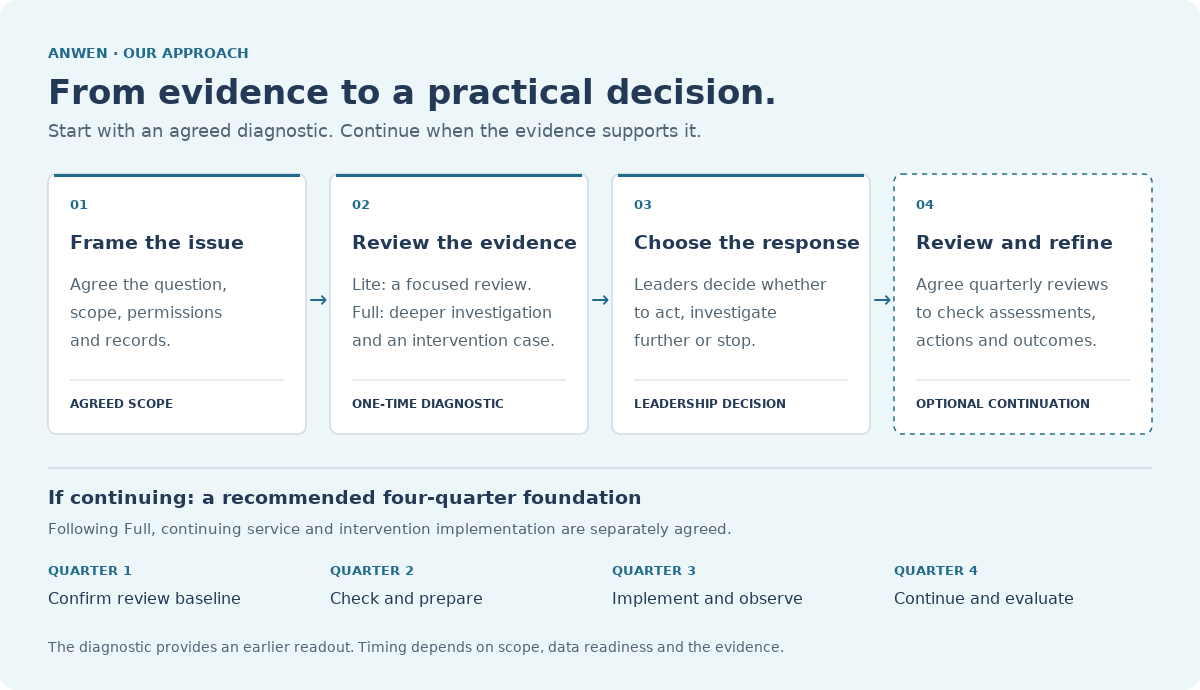
The engagement path

From a question to an owned decision.

Open the engagement graphic

If continuing

A four-quarter foundation for review.

Full examines historical records to establish a retrospective baseline. Continuing work uses that starting point to build a prospective evaluation record. We recommend four quarters, including two quarters of intervention implementation and observation.

The diagnostic supports an earlier decision. The sequence is a planning recommendation, not a guarantee of model accuracy or business impact; the evidence and business needs determine the agreed timetable.

See the recommended four-quarter sequence
  1. Quarter 1

    Confirm the review baseline

    Carry the diagnostic’s historical findings into agreed success measures, financial assumptions and a prospective review plan. Record evidence limits and owners.

  2. Quarter 2

    Check and prepare

    Compare assessments with new observations, check whether patterns hold and prepare the intervention plan and a feasible comparison.

  3. Quarter 3

    Implement and observe

    Record implementation, participation, costs, delivery conditions and employee feedback where available.

  4. Quarter 4

    Continue and evaluate

    Observe through a second implementation quarter. Review outcomes, complete costs and culture measures against the preserved baseline and agreed comparison.

Four quarters may still leave insufficient evidence for some conclusions. Timing and any earlier action are agreed for the business decision.

Calibration over time

Check assessments against what follows.

Each quarterly review is an opportunity to test earlier assessments against later workforce outcomes and refine the analysis where the evidence supports it.

How do model review and business-impact review differ?

Model review: preserve earlier assessments, check data changes and compare them with later outcomes. Test candidate adjustments using outcomes that were not used to fit the change; retain the current version when the evidence does not justify improvement.

Business-impact review: record actions, participation, complete costs, continuity and culture measures. Evaluate them against the original baseline and a credible comparison where feasible, accounting for other changes. Better model calibration alone does not prove an intervention caused improvement.

This recommended process depends on evaluated capabilities and permissions confirmed for the engagement. Improvement must be demonstrated, not assumed.

Data and delivery

Agreed before records are shared.

Scope, processing location, permitted access, support, retention and deletion are documented before intake.

Where can the work be processed?

The Full diagnostic can be scoped to run on a server managed by Anwen or on equipment at your location, subject to confirmed capabilities and approval for your engagement. The processing location and responsibilities for equipment, installation, support and recovery are documented before work begins. Deployment at your location is separately quoted.

Why participate in model learning?

We recommend Model Learning Participation to help Anwen learn from workforce patterns and outcomes across participating companies. That broader evidence can inform future models and give your company’s analysis a wider foundation than its own records alone.

Only data that meets the agreed de-identification, aggregation and privacy-review requirements may be used for shared learning. Employee and company identifiers must be removed before that use.

Participation is optional and agreed separately in writing. Proposed refinements are checked against your company’s outcomes before adoption.

What are the continuing-service terms?

A continuing engagement is separately agreed after the diagnostic. The annual term is twelve months, with one scheduled refresh and review each quarter; reviews are not cancellation windows. There is no automatic Lite-to-Full upgrade or annual commitment.

Standard annual implementation and routine maintenance are included within agreed scope, without a separate setup fee or per-seat charge. Investment, any customer-site deployment and expanded scope are confirmed in the written proposal. Neither analysis nor continuing service guarantees avoided departures, savings or predictive accuracy.

Start with the decision on your desk.

A first conversation needs a business question, not employee records.

Discuss a diagnostic